What Is Vapor Chamber Cooling in Smartphones?
A modern smartphone can edit a video, navigate a city, run a demanding game, and charge at the same time, all inside a body not much larger than a chocolate bar. That much activity creates heat. If the heat stays trapped around the processor, the phone slows down, the frame rate becomes uneven, and the surface can feel uncomfortable. Vapor chamber cooling is one of the clever ways engineers move that heat away from the hottest spots.
The term sounds futuristic, but the basic idea is familiar. Water absorbs energy when it evaporates, and it releases energy when it condenses. A vapor chamber uses this phase-change process in a very thin sealed metal package. This guide explains what a vapor chamber is, how it works, where you will find one, and what it can and cannot do. It is not a tiny air conditioner, and it will not make a phone stay cool forever. It is part of a carefully tuned thermal design.
What Is a Vapor Chamber?
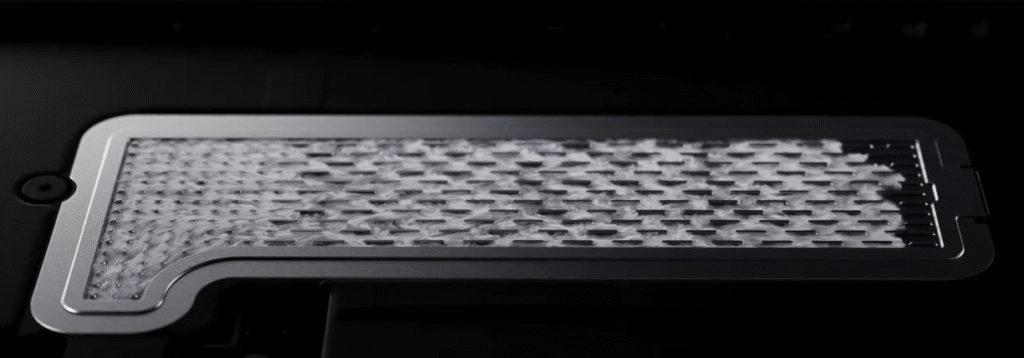
A vapor chamber is a flat, sealed heat-spreading component. Inside it is a small amount of working fluid and a porous structure called a wick. The chamber is usually made from copper or another material with good thermal conductivity. It sits near heat-producing parts such as the processor, modem, or power-management chip. The goal is not to create cold air. The goal is to spread concentrated heat across a wider area so it can leave the phone more gradually.
A vapor chamber is related to a heat pipe, but the geometry is different. A heat pipe moves heat along a narrow path. A vapor chamber spreads heat across two dimensions, more like a thin plate. That makes it useful in phones, where available space is limited and designers need to cool a small hotspot without adding much thickness. The chamber may cover several components, or a large one may be placed above the main circuit board.
Not every phone with a vapor chamber uses the same design or performance level. Material, thickness, internal wick, fluid pressure, mounting, and surrounding graphite or metal layers all matter. “Vapor chamber cooling” is therefore a technology category, not a promise that every phone will remain cool in every task.
How Does It Work?
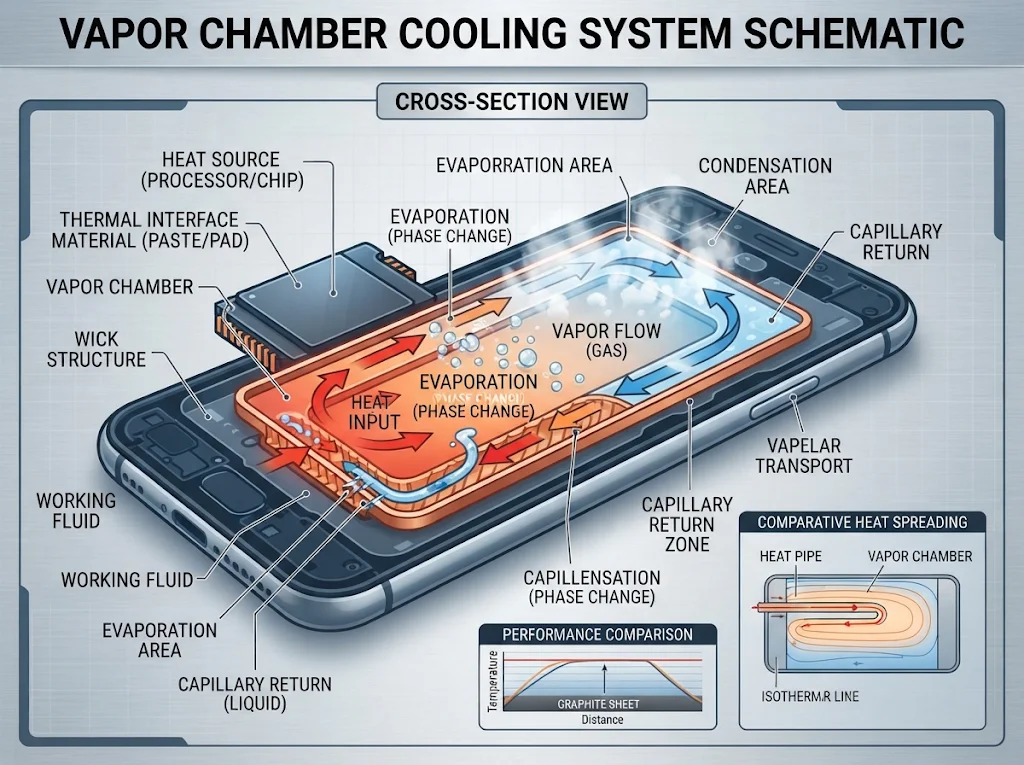
The cooling cycle starts when heat reaches the chamber’s hot side. The working fluid evaporates at a temperature well below the phone’s maximum operating limit. Evaporation absorbs energy, and the vapor moves quickly toward cooler regions of the chamber. When the vapor reaches those cooler areas, it condenses back into liquid and releases heat. The metal walls and connected thermal spreaders then pass that heat toward the phone’s outer surface, where it can dissipate into the surrounding air.
The wick returns the liquid to the hot side, where it can evaporate again. In a well-designed chamber, this happens continuously and passively, with no pump or fan. The wick’s capillary action is important because a phone may be held at different angles. A device that works only when perfectly level would not be a practical phone component. Gravity can influence performance, but capillary structures are designed to keep the cycle moving.
The chamber is only one part of the route. Heat must first pass through thermal interface materials from the chip to the chamber. It must then move through the chamber, into the frame, and finally across the screen, back cover, or other surfaces. If one link is weak, the whole system suffers. This explains why two phones with similar chips can perform differently. A vapor chamber may reduce a local hotspot and allow a processor to keep a higher speed for longer, but the phone’s software must still limit power when the overall body becomes too warm.
Unlike a fan, the chamber has no moving parts, so it is quiet and does not collect dust. Unlike a refrigerator, it does not actively pump heat into a space outside the device. It temporarily spreads and transports heat within the phone. The device still depends on surface area and room conditions to remove that energy. On a hot day, in direct sunlight, or under a thick case, the same phone may feel warmer even if its vapor chamber is working normally.
Key Components and Technologies
The outer shell gives the chamber its shape and helps conduct heat. A copper enclosure is common because copper handles heat well and can be formed into thin walls. Inside, the wick may use sintered metal powder, grooves, mesh, or another porous structure. The working fluid is selected to evaporate and condense in the expected temperature range. Support posts can keep the thin walls from collapsing while preserving space for vapor movement.
Manufacturing quality is critical because the chamber must remain sealed. Even a tiny leak can change the pressure and reduce performance over time. The internal surfaces must be clean, and the amount of fluid must be controlled. The chamber is bonded to the heat source and other cooling layers, often with thermal paste, pads, or solder. Graphite sheets and copper foil may spread heat further, while the metal frame can act as a large passive radiator.
Smartphone software also belongs in the cooling system. Thermal sensors monitor the battery, processor, and device skin temperature. When a limit is approached, the system can reduce processor frequency, dim the display, limit charging, or reduce camera processing. A vapor chamber gives the software more headroom, but it does not remove the need for those safeguards. The best result comes when hardware and software work together rather than treating the chamber as a standalone solution.
Real-World Applications
Vapor chambers are most visible in thin flagship phones and gaming phones. They help during long gaming sessions, video recording, photo processing, navigation, and software updates. A phone without effective cooling may run well for the first few minutes and then throttle. A stronger thermal system can often sustain more consistent performance, though it may also spread warmth over a broader area of the phone’s back and sides.
The technology can support fast charging when the battery and charging circuit generate heat. It can also help 5G modems and camera modules during heavy use. Device makers sometimes describe the total cooling area or compare the chamber with graphite-only designs. Those numbers are useful only when the test conditions and the complete thermal path are clear. A large chamber mounted poorly may deliver less benefit than a smaller chamber with better contact and better airflow around the phone.
For buyers, the practical question is not simply “Does it have a vapor chamber?” It is “Does this phone maintain acceptable performance and comfort in the tasks I use?” Reviews that measure sustained frame rates, surface temperatures, charging speed, and camera recording limits are more informative than a feature badge alone. Case choice and environment also matter. A thick insulated case can trap heat, while a cooler room and an uncovered back can improve heat loss.

Advantages and Limitations
The biggest advantage is efficient heat spreading in a very thin package. A vapor chamber can reduce a concentrated hotspot and move energy toward more surface area. It works silently, has no fan, and can be shaped to fit modern phone layouts. It may help sustain performance, improve comfort during demanding tasks, and give engineers more freedom when designing slim devices with powerful chips.
The limitations are equally important. A vapor chamber is passive, so it cannot make heat disappear if the phone’s outer surface cannot shed it. Under very long loads, the phone may eventually reach the same thermal limit as a less advanced design. Manufacturing is more complex than using a simple graphite sheet, and the chamber can add cost. Mechanical damage or a poor seal can reduce performance, and the benefit varies with chamber size, orientation, mounting, and surrounding materials.
Consumers should ignore unrealistic claims. A phone with a vapor chamber can still become warm while charging in the sun. It contains no user-serviceable liquid, so never puncture or bend the assembly. If the phone becomes extremely hot or shows a temperature warning, stop the demanding task and let it cool.
Frequently Asked Questions
Does a vapor chamber contain water? It contains a carefully selected working fluid and is permanently sealed at the factory. You should not open, refill, or repair it yourself. The exact fluid and pressure depend on the design.
Will a vapor chamber make my phone cold? It helps move and spread heat, but the phone still warms up. Cooling is a matter of slowing the temperature rise and preventing a hotspot from becoming worse than the rest of the device.
Is it better than a heat pipe? Both can be effective. A vapor chamber usually offers broader two-dimensional spreading, while a heat pipe moves heat along a path. The complete thermal design matters more than the label.
Does a vapor chamber prevent throttling? It can delay throttling or make performance more consistent, but it cannot guarantee full speed indefinitely. Every phone has thermal and battery limits.
Final Words
Vapor chamber cooling is a passive thermal technology that uses evaporation, vapor transport, condensation, and capillary return to spread heat inside a smartphone. It is especially useful where engineers need to manage a powerful chip in a thin body. It can improve sustained performance and reduce local hotspots, but it is not a fan, an air conditioner, or a guarantee of endless full-speed operation. The best way to judge it is to look at the whole phone, including materials, software limits, real-world temperature, and long-duration test results. When understood clearly, vapor chamber cooling is a practical engineering tool rather than a magic cooling feature.