OLED vs AMOLED: What Is the Difference?
Walk through a phone store or read a product page and you will meet two display terms that sound as if they belong to different worlds: OLED and AMOLED. One seems to be the basic technology, while the other sounds like a premium upgrade. The truth is more interesting and a little less dramatic. AMOLED is closely related to OLED, and in many modern phones the names are used in ways that describe both the light-emitting material and the circuitry that controls it.
Knowing the difference helps you read specifications without being distracted by marketing language. It also helps you understand why two screens can look very different even when both are called OLED. This guide explains the relationship between OLED and AMOLED, how the pixels work, what active-matrix means, and which practical factors matter when you choose a phone. The short version is simple, but the details explain why display quality is never determined by one label alone.
What Is OLED?
OLED stands for organic light-emitting diode. In an OLED display, each pixel produces light when an electrical current passes through organic materials. Because the pixels emit their own light, the display does not need a separate backlight like an LCD. A black pixel can be switched nearly off, which helps create deep blacks, high contrast, and slim panel designs. OLED panels can also be built on flexible substrates, enabling curved and foldable phones.
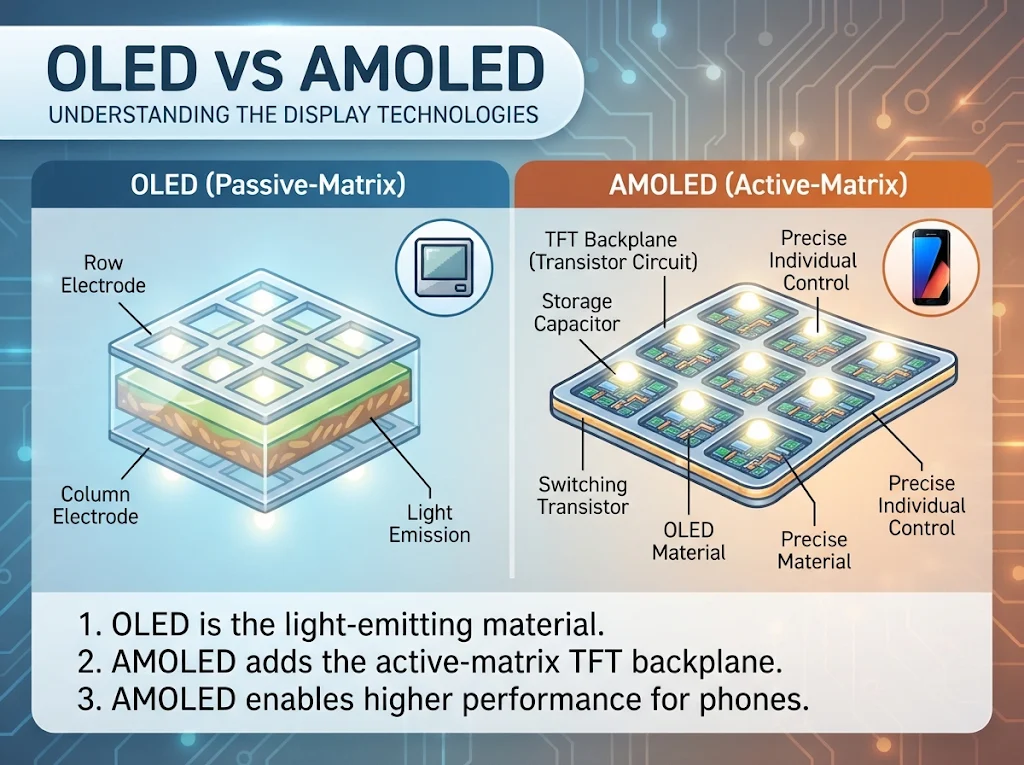
There are different ways to control OLED pixels. A passive-matrix OLED, or PMOLED, uses simpler row-and-column driving and is common in small or low-resolution displays. An active-matrix OLED, or AMOLED, places a thin-film transistor circuit at each pixel. That transistor acts like a local switch and storage element, allowing faster and more precise control of a large pixel array. AMOLED is therefore a type of OLED, not a completely separate light-producing technology.
In everyday marketing, “OLED” may refer to a generic OLED panel, while “AMOLED” often describes an active-matrix panel with particular materials or manufacturing methods. Some brands use “AMOLED” for phones and “OLED” for televisions or monitors, but the names do not guarantee identical performance. You still need to compare resolution, brightness, color calibration, refresh rate, viewing angles, and other specifications.
How Does It Work?
An OLED pixel includes a stack of organic layers between electrodes. When current flows, electrons and holes combine in the emissive layer and release energy as light. The color depends on the materials and the structure of the subpixel. Many phone displays use separate red, green, and blue subpixels, while other designs use color filters or additional white subpixels. The exact arrangement influences efficiency, color, brightness, and the visibility of fine details.
In an AMOLED display, each pixel has a transistor circuit. Row and column signals select the pixel, a storage capacitor holds a charge, and the circuit controls the current through the OLED material during the frame. This active control is one reason AMOLED can support high resolution, fast refresh, and precise dimming. A display driver sends image data to the panel, and timing logic coordinates millions of tiny circuits.
The display is not just a glowing layer. It needs encapsulation to protect organic materials from oxygen and moisture, a substrate for mechanical support, and often polarizers, touch layers, and cover glass. Flexible AMOLED panels use thin encapsulation and a flexible substrate so the screen can bend. Low-temperature polycrystalline oxide, or LTPO, backplanes can adjust refresh rates more efficiently by switching transistor behavior as needed. That is why an OLED phone can save power when the screen is static and become smoother when you scroll.
Perceived image quality depends heavily on calibration. A panel can have excellent contrast but inaccurate white balance, excessive saturation, noticeable flicker at low brightness, or aggressive automatic brightness. The way software maps colors and brightness can matter as much as the panel label. Good reviews measure these behaviors instead of assuming that every AMOLED is automatically superior.
Key Components and Technologies
The emissive layers contain organic materials that produce red, green, and blue light. Electrodes inject charge, while transport layers help the charges reach the emissive region. A thin-film transistor backplane controls each pixel; AMOLED relies on this active matrix. A driver integrated circuit sends signals to the panel, and timing controllers keep rows and columns synchronized. Encapsulation protects the organic stack, and the cover glass protects the user-facing surface.
Color filters and subpixel layouts affect sharpness and efficiency. Some panels use a PenTile-style arrangement in which subpixels are shared or arranged differently to balance manufacturing and brightness. Resolution specifications should be considered together with the actual subpixel pattern. Touch sensing may be integrated into the panel or added as a separate layer. A polarizer reduces reflections but can also reduce brightness, so some advanced panels use alternative anti-reflection structures.
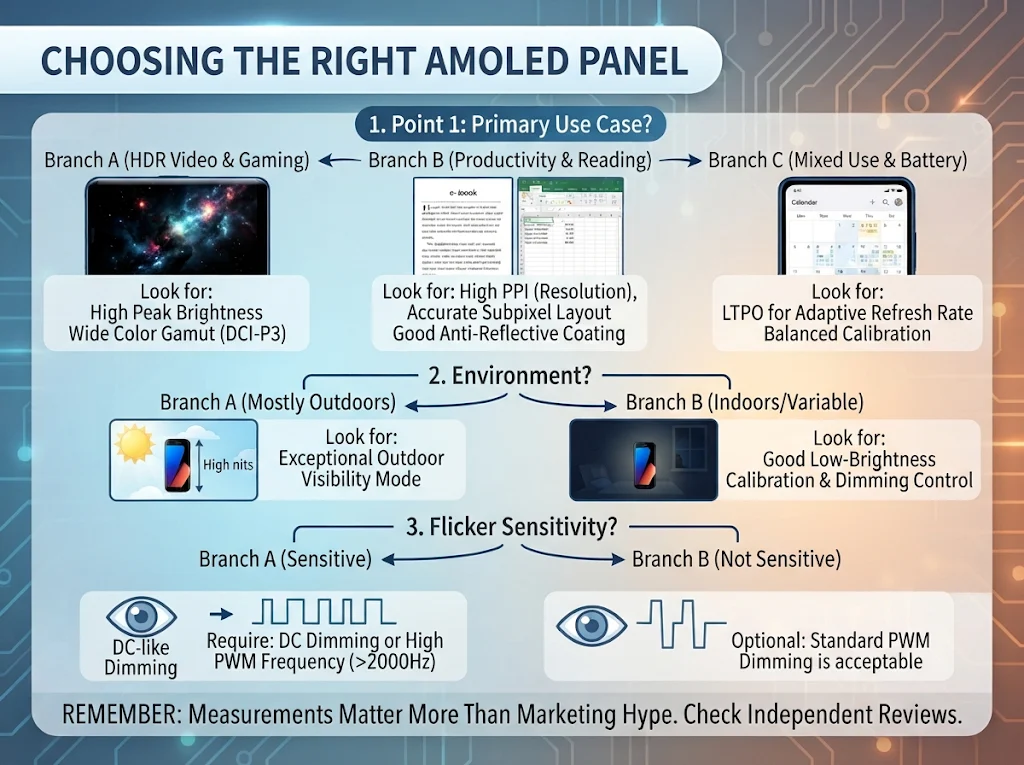
Refresh-rate technology is another part of the system. A standard panel might run at a fixed rate, while an adaptive panel can drop to a low rate for static content and rise quickly for games or animation. LTPO is common in high-end phones because it can improve efficiency. None of these features is exclusive to the word AMOLED, however. Two AMOLED phones can have very different driver circuits, brightness limits, and power behavior.
Real-World Applications
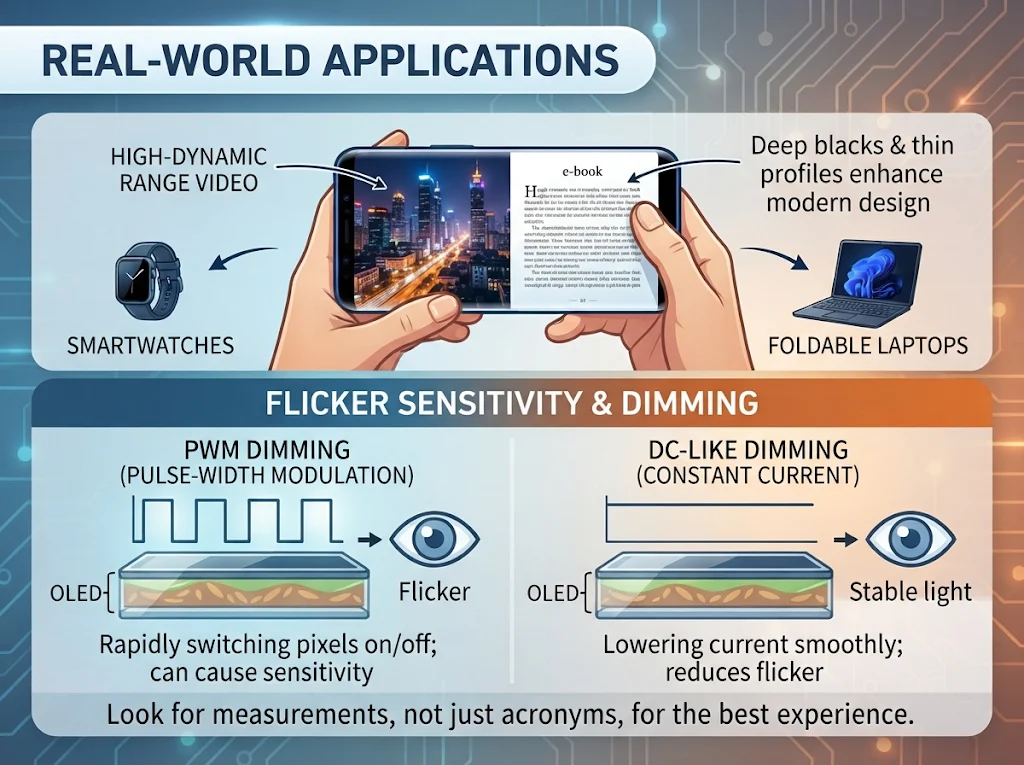
OLED and AMOLED are common in premium smartphones, smartwatches, portable gaming devices, and some laptops. Their deep blacks and thin profiles suit modern industrial design. In a phone, an OLED display can show bright highlights against dark backgrounds for HDR video, and flexible OLED panels enable folding designs. AMOLED’s active control is useful for high-resolution screens and dynamic refresh rates.
In daily use, the difference between two good panels may be less obvious than the difference between good and poor calibration. Reading text in bright sunlight depends on peak brightness and reflection handling. Watching video depends on contrast, color accuracy, and tone mapping. Playing games depends on touch response and sustained brightness. A screen that looks impressive in a dark store may struggle outdoors, and a very bright screen may consume more power or create more heat.
For people who are sensitive to flicker, pulse-width modulation is worth checking. Some OLED panels dim by rapidly switching pixels on and off rather than lowering current smoothly. A high modulation frequency may be less noticeable to many users, but sensitivity varies. DC-like dimming or special low-flicker modes can help. Buyers should test a phone in person when possible and read measurements rather than relying only on the OLED or AMOLED name.
Advantages and Limitations
OLED technology offers excellent contrast, fast pixel response, wide viewing angles, and thin or flexible form factors. Individual pixels can turn dark, which is useful for dark interfaces and battery savings with black content. AMOLED adds active control that supports large, high-resolution arrays and advanced refresh features. These strengths explain why OLED has become standard in many premium phones.
The limitations include cost, manufacturing complexity, and possible burn-in. Static interface elements can leave a faint ghost over long periods, especially when the panel operates at high brightness for many hours. OLED brightness may be limited by heat and material lifetime, and some panels use PWM dimming that can bother sensitive users. Blue organic materials may age differently from red and green, so color management and compensation are important.
“AMOLED” does not automatically mean “better OLED.” It usually describes active-matrix construction, which is already common in high-quality OLED phones. A well-calibrated basic OLED may beat a poorly tuned AMOLED in color accuracy or comfort. Compare the full specification and independent measurements. Also consider warranty and repair costs, because replacing a flexible or high-brightness panel can be expensive.
Frequently Asked Questions
Is AMOLED a type of OLED? Yes. AMOLED uses OLED materials with an active-matrix backplane. The two terms overlap, although marketing departments do not always use them consistently.
Is AMOLED always better than OLED? No. AMOLED can enable excellent performance, but the result depends on panel quality, calibration, brightness, refresh rate, flicker, and the device’s software.
Do OLED screens really produce pure black? They can turn individual pixels very close to off, producing very deep blacks. Reflections from the cover glass and ambient light can still make a black screen look gray in a bright room.
Should I worry about burn-in? It is less common in normal mixed use than during years of static high-brightness content. Dark mode, sensible brightness, and screen-time habits can reduce risk. Warranty terms vary by manufacturer.
Conclusion
OLED is the family of displays in which organic pixels create their own light. AMOLED is generally an OLED display with an active-matrix transistor circuit for precise pixel control. In modern phones, the practical differences depend on the panel design, generation, calibration, brightness, and software rather than the two acronyms alone. Look for independent measurements, test the screen in realistic light, and consider flicker sensitivity and burn-in risk. Understanding the relationship removes the marketing fog and lets you choose a phone by the display experience you will actually notice.